Idea-cation @ UTMThis year, participants will join the "Innovation for the Future in Guangdong: Macao Youth Entrepreneurship Tour to Jiangmen 2026," (‘粵創未來 濠聚江門’ 2026澳門創業青年江門行) a 2-day, 1-night field trip visiting several unique sites and experiencing a range of tourism offerings. Participants go underground at a major particle physics laboratory, walk through the UNESCO-listed Kaiping Diaolou and its villages, and spend time at Wuyi University with the China-Germany AI Institute. Between the visits there is a village banquet, an evening of music, and free time in the countryside. Each stop gives teams first-hand material for their proposal. 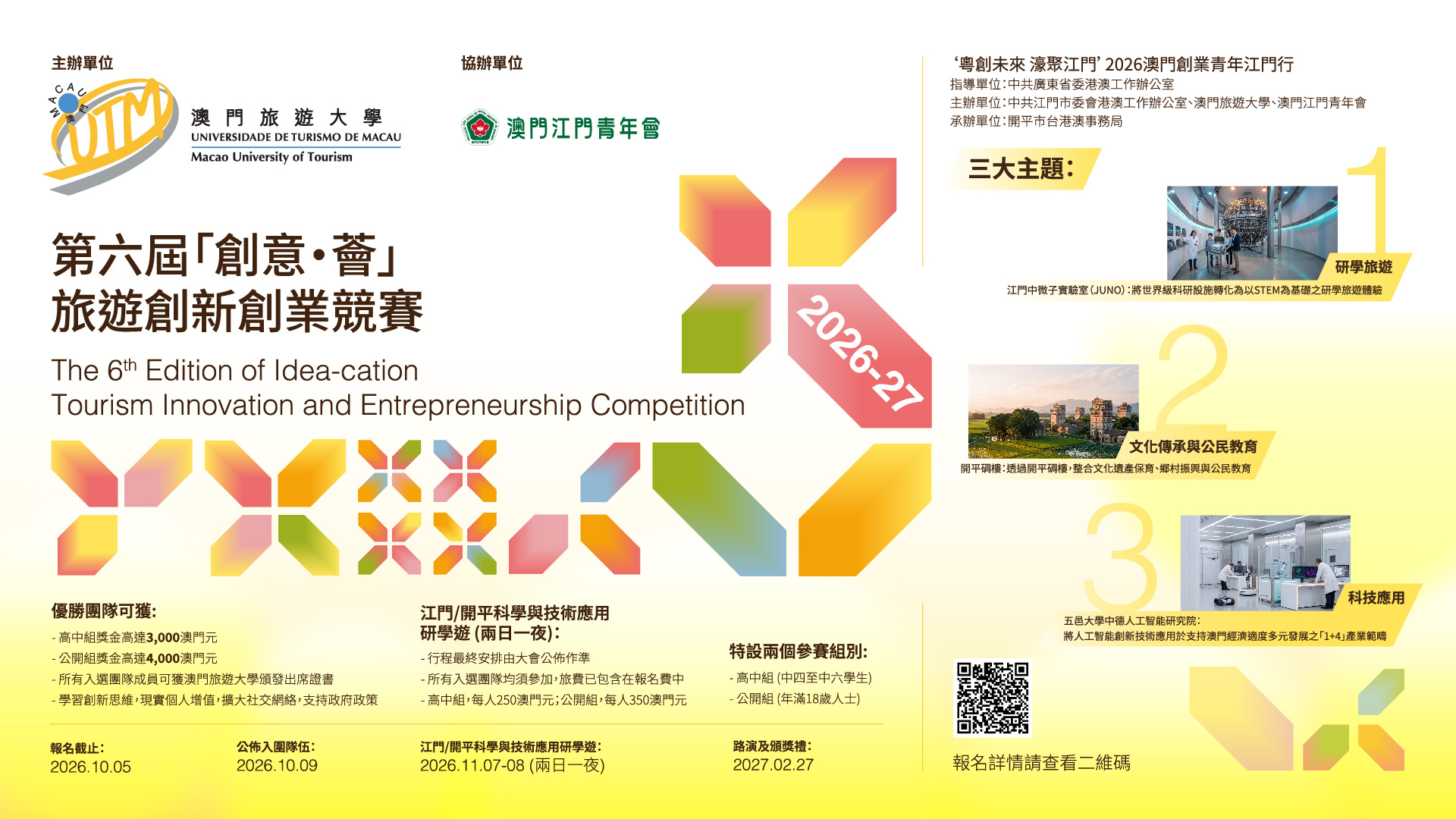
Key Dates
* Overseas applicants will need to cover the costs of their visa. Study Tour to Jiangmen/KaipingThis is a two-day, one-night trip to Jiangmen and Kaiping, organised around three visits, one for each competition track. Participants go underground at a major particle physics laboratory, walk through the UNESCO-listed Kaiping Diaolou and its villages, and spend time at Wuyi University with the China-Germany AI Institute. Between the visits there is a village banquet, an evening of music, and free time in the countryside. Each stop gives teams first-hand material for their proposal. Three VisitsThe trip is built around three site visits, one per theme. Each visit takes place on site and gives participants direct contact with the work and the people behind it. Theme 1: Jiangmen Underground Neutrino Observatory (JUNO)The Theme 1 visit is to the Jiangmen Underground Neutrino Observatory (JUNO), a major particle physics laboratory. Participants take part in a safety briefing and underground training before descending more than 700 metres into the mountain to the detector hall. Few people outside the research community go down to that level, and the visit shows what the facility is and how the work is carried out. The design question that follows is how a site of this kind, which the public cannot normally enter, can be turned into an educational tourism experience. Theme 2: Kaiping Diaolou and VillagesThe Theme 2 visit is to the Kaiping Diaolou and Villages, a UNESCO World Heritage site. Participants walk among the diaolou, the multi-storey towers built by overseas Chinese families, and through the surrounding villages. They hear how the towers came to be built, how the diaspora shaped the area, and how its heritage and community life are maintained today. The material gathered here supports the design of a heritage tourism experience that connects culture, civic values and rural revitalisation. Theme 3: Wuyi UniversityThe Theme 3 visit is to Wuyi University and its China-Germany AI Institute. Participants tour the campus and the Industrial Training and Intelligent Manufacturing Hall, meet staff and students, and see demonstrations of artificial intelligence, digital heritage and smart tourism. The visit shows the technologies that can support Macao’s ‘1+4’ economic diversification, and gives teams the chance to ask how they are used in practice. Food, Music and Free TimeThe trip is not only visits. In the evening there is a village banquet with local Kaiping dishes, along with the firecrackers and celebration that accompany a rural welcome. Afterwards there is an informal evening of music and shared reflections, which gives participants from different schools a chance to meet. There is also free time to walk the village lanes, meet residents and take photographs, and to explore the creative town, where old buildings have been converted into bookshops, studios, cafés and guesthouses. Practical DetailsDates: 7-8 November 2026 (two days, one night). |
Mode of ParticipationIn-person |
||||||||
Who May Participate?
|
||||||||
Team Size
|
||||||||
Working LanguagesChinese as the main language for communication, supplemented by English |
||||||||
Three Competition ThemesApplicants may choose one of the following tracks by indicating their preferred theme in the online application form: |
||||||||
Entry fee (non-refundable)
The above entry fees cover the study tour, expert talks, and seminars. The fees are non-refundable. |
||||||||
Competition RequirementsParticipants are expected to actively participate in all activities. |
||||||||
Evaluation CriteriaThe four assessment items are as follows: |
||||||||
Team Prizes and Awards
|
||||||||
Value-Added Benefits for Personal and Career Development• Learn how to apply entrepreneurial and innovative thinking |
 Trophy (gold), winning certificate, with MOP 3,000 cash
 Trophy (silver), winning certificate, with MOP 2,000 cash
 Trophy (bronze), winning certificate, with MOP 1,000 cash
Application and Payment |
|
Online Application |
|
As the number of available places is limited, applications will be assessed on a rolling basis. The selection committee will prioritise applications that demonstrate quality, originality, and innovation. Qualified teams may be admitted as applications are received. |
|
For enquiries, please email: ideation-lab@utm.edu.mo |
Judges |
Mentors |
Organising Committee |